Hanshu
The Heart of a DogAtavism is the term Professor Preobrazhensky uses to explain the reversal of Sharikov’s humanized state: after speaking as a person, he begins returning to what the professor calls his primitive state. The concept gives the experiment’s ending a biological explanation, but the scene also makes identity a matter of public proof: the restored dog is produced before witnesses who had come to investigate the alleged murder of Poligraph Poligraphovich Sharikov.
The Experiment and Its Names
The subject began as Sharik, a male mongrel dog estimated to be about two years old. The name first enters through the professor’s encounter with him: after offering him a piece of sausage, the gentleman calls him Sharik, and the hungry dog accepts the name along with the food. Later, the experiment’s case notes identify the subject by sex, approximate age, breed, and name, reducing the living animal to a formally described subject of study.
After the transformation, the man chooses the name Poligraph Poligraphovich. When Shvonder asks what surname he will take, he insists on using his real name. Shvonder then proposes a certificate identifying him as Poligraph Poligraphovich Sharikov and gives the flat as his place of birth. The professor rejects that account, maintaining that Sharikov was not born in the flat. The sequence links naming to competing claims about origin: the new name supports an administrative identity, while the professor’s account insists on the experimental creation behind it.
Reversal and Its Explanation
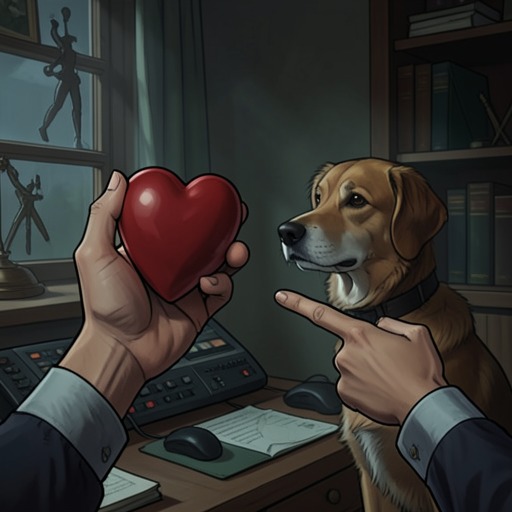
The final demonstration takes place after Sharikov has been missing for ten days and the household faces an accusation that its members murdered him. At the professor’s request, Doctor Bormenthal brings Sharik into the study. The dog’s coat has grown back in patches, and a crimson scar remains on his forehead. He first enters on his hind legs, then drops to all fours, looks around, and sits in an armchair after rising again. The changes are not described as a complete disappearance of the humanized form: the dog still displays learned behavior even as his body and movement register the return.
The man in black points out that Sharikov had talked. Professor Preobrazhensky replies that Sharik still talks, but less and less, and explains that the attempt to turn animals into people has failed: Sharikov spoke, then began to revert to his primitive state. He names this process atavism. The explanation connects the observable signs—the changing coat, the altered movement, and diminishing speech—to a single reversal in the experiment’s outcome.
Evidence, Identity, and the Ending
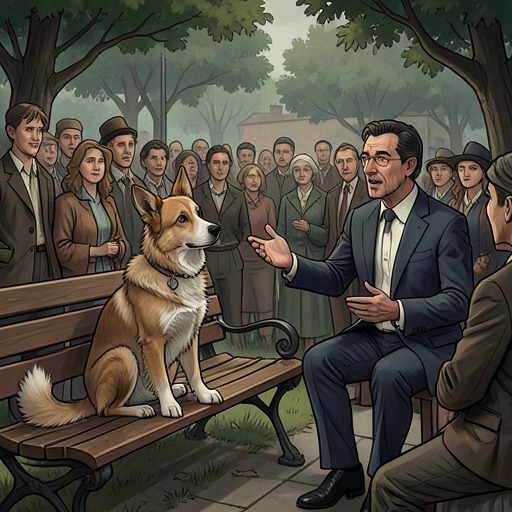
The restored dog appears not in a private laboratory observation but before the investigators and witnesses assembled over the charge that Poligraph Poligraphovich Sharikov was murdered. The accusation lists Professor Preobrazhensky, Doctor Bormenthal, Zinaida Prokofievna Bunina, and Darya Ivanova as the accused. The professor’s response is to identify the supposed victim as his dog, the one on whom he operated, and Bormenthal then produces Sharik before the room. The body itself becomes evidence against the charge, although its extraordinary appearance leaves the witnesses struggling to reconcile the dog with the man they knew.
The scene does not simply replace one stable identity with another. Sharik is recognizably the dog who was brought into the experiment, but he bears the scar, retains traces of human conduct, and can still speak briefly. The witnesses confirm that this is the missing animal, while the professor’s account frames the change as a failed humanization followed by atavistic return. The concept therefore marks both the outcome of the experiment and the limit of what its observers can claim: they can see the reversal, but the hybrid signs of the transformation remain before them.